




Healthcare and Quality of Life
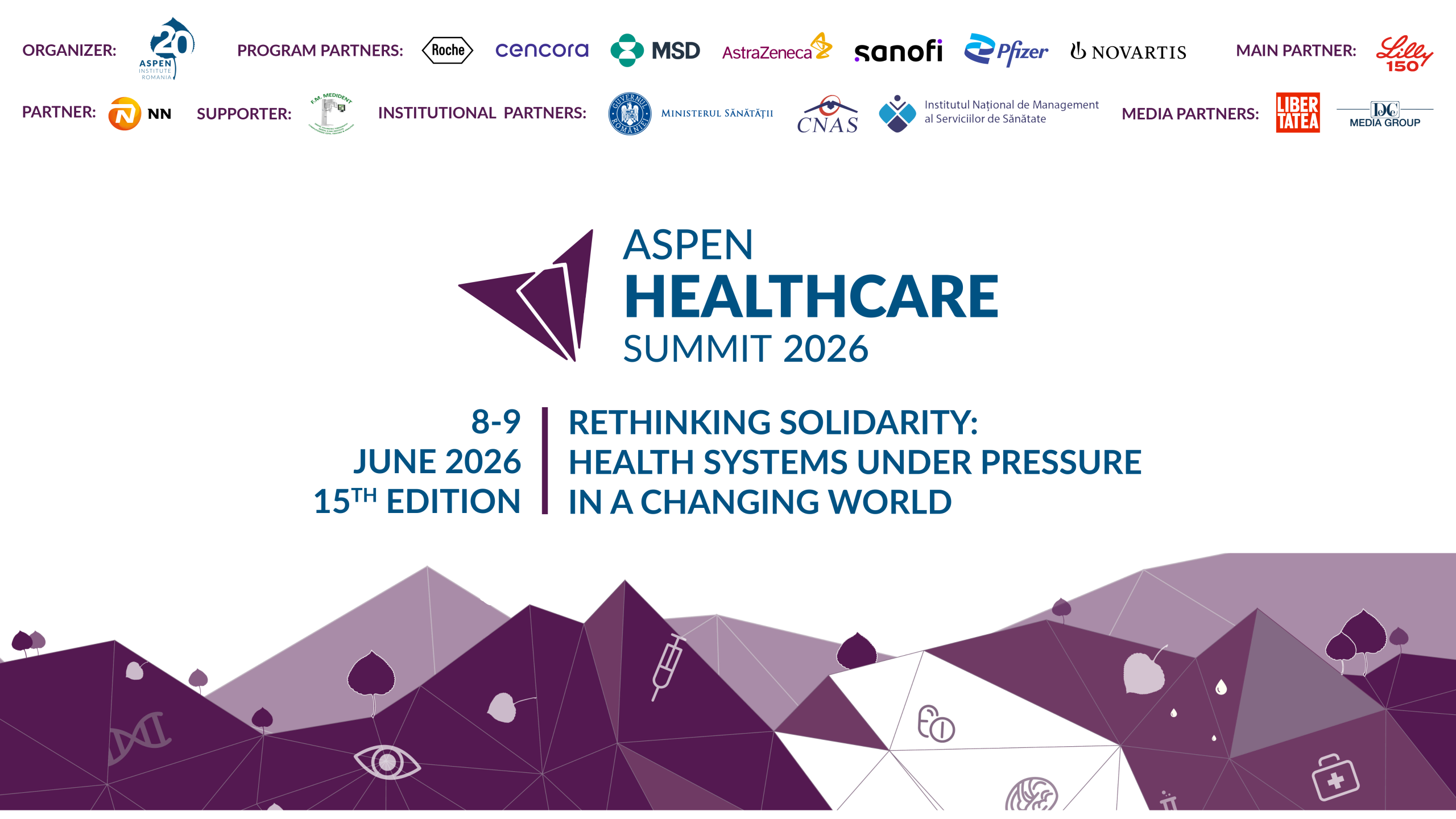
Aspen Healthcare Summit 2026
Rethinking Solidarity: Health Systems Under Pressure in a Changing World
June 8 & 9, 2026, Bucharest
15th Edition
Aspen Healthcare Summit, at the 15th edition in 2026, is the major public event of Aspen Institute Romania’s Healthcare & Quality of Life Program, bringing together decision-makers, renowned specialists and researchers from the medical sector, European and national healthcare experts, representatives of non-governmental organizations and academia, representatives of health technology and pharmaceutical sector, as well as industry leaders engaged in developing health policies. Last years’ editions contributed to setting up a program community and an agenda of thematic priorities in convergence with national priorities and advanced technological solutions as well as the EU regulatory framework and WHO goals.
European healthcare systems have, for decades, been built on a foundational principle: solidarity. The idea that health is not solely an individual responsibility, but a shared societal good, has underpinned the expansion of access, public investment, and trust in public institutions. Today, however, this model is under growing pressure.
Aging populations, rising costs driven by medical innovation, workforce shortages, and increasing fiscal constraints are converging into a structural challenge for health systems across Europe. At the same time, expectations from patients and society continue to grow, while technological advances are rapidly reshaping how care can be delivered and governed. In this context, the question is no longer whether systems need to change, but how far the principle of solidarity itself can stretch under pressure.
Aspen Healthcare Summit 2026, under the title “Rethinking Solidarity: Health Systems Under Pressure in a Changing World”, is built around this central tension and serves as a platform for strategic dialogue and exchange of ideas among healthcare leaders, policymakers, researchers, and innovators. As the flagship event of the Aspen Institute Romania’s Healthcare & Quality of Life Program, the Summit embodies the values of equity, resilience, and collaboration, fostering a space where sustainability, evidence-based policy and shared European values guide discussions on the future of healthcare systems.
This year’s edition of the Summit will consist of an Aspen Dialogue and Networking Reception on the afternoon of June 8th, followed by the main public conference on June 9th. The event will explore a set of interconnected transformations shaping healthcare systems today: the implications of longevity and active aging on system design and demand; the sustainability of health financing under increasing pressure on solidarity-based models; and the role of digitalization and data, particularly in the context of the European Health Data Space (EHDS) and digital health initiatives in Romania, as a prerequisite for more efficient and prevention-oriented care. Key sessions will bring together system-level perspectives, including insights from the forthcoming Health System in Transition (HiT) Romania review, alongside focused conversations on access and service delivery, such as the role of telemedicine, as well as emerging pressures in areas like mental health and addiction.
Through a combination of panels and moderated conversation, the Summit aims to move beyond diagnosis and contribute to a more grounded understanding of how healthcare systems can adapt—while preserving their core principles—in a context of sustained pressure and change. Ultimately, the Summit is anchored in a fundamental question: Can solidarity remain the central organizing principle of healthcare systems in a changing world—and if so, in what form? The answer will depend not only on available resources, but on our ability to rethink how health systems are financed, organized, and aligned with the realities of a society under pressure.
The Aspen Dialogue on the afternoon of June 8th builds on last year’s launch of the Mind, Body and Spirit Initiative, continuing its focus on fostering holistic leadership in healthcare. As a natural extension of this effort, the 2026 sessions will center on longevity and active aging, bringing forward discussions at the intersection of healthcare, quality of life, healthy lifestyles, and personal and social wellbeing. Anchored in the Aspen Method, the Dialogue will continue to develop a dedicated, cross-sector community of stakeholders, while deepening the Institute’s engagement with themes that connect individual wellbeing with broader system transformation.
Aspen Healthcare & Quality of Life Program Partners 2026: Roche, Cencora, Merck Sharp & Dohme, AstraZeneca, Sanofi, Pfizer, Novartis
Aspen Healthcare Summit 2026 Main Partner: Eli Lilly Romania
Aspen Healthcare Summit 2026 Partner: NN Asigurări
Aspen Healthcare Summit 2026 Supporter: F.M. Medident
Institutional Partners: Ministry of Health, National Health Insurance House, National Institute of Health Services Management
Media Partners: Libertatea, DC Media Group
Agenda
June 8th
16:00 – 16:30 Participants’ Registration & Welcome Coffee
16:30 – 16:40 Welcome Remarks
- Mircea Geoană – President, Aspen Institute Romania
16:40 – 17:10 Conversation on Health Equity and Rare Diseases
Rare diseases are among the most demanding tests of solidarity in modern health systems. Though individually uncommon, they collectively affect a significant share of the population, with patients facing long diagnostic journeys, fragmented care, and uneven access to innovative therapies. This conversation will examine how Romania and other European health systems respond to these realities and what rare diseases reveal about the way priorities are set, resources are allocated, and responsibility is shared in practice, ultimately shaping how equity is experienced by patients.
- Gergely Meszaros – Policy Advisor, European Pulmonary Fibrosis Federation (EU-PFF)
- Radu Gănescu – President, COPAC
Moderator: Horea Chirilă – Assistant Professor – Paediatric Neurology, “Carol Davila” University of Medicine and Pharmacy / Fellow, Aspen Young Leaders Program
17:10 – 17:40 Active Aging in Practice – From Living Longer to Living Better
As longevity reshapes societies, the focus is shifting from simply living longer to living better. This session will explore the critical role of active aging policies in supporting senior populations, while also examining how healthcare and social systems must adapt to meet their evolving needs. Bringing together expert speakers, the conversation will address how prevention, community-based support, and age-friendly system design can improve quality of life for older adults and reduce long-term pressure on healthcare systems. The discussion will offer practical insights into how societies can better prepare for an aging population while preserving independence, dignity, and wellbeing.
- Luiza Spiru – Professor of Gerontology and Longevity Medicine, “Carol Davila” University of Medicine and Pharmacy
Moderator: Alexandra Dobre – PhD, Founder, Institutul Român pentru Îmbătrânire Activă
17:45 Cocktail & Networking Reception
June 9th
08:30 – 09:00 Registration & Welcome Coffee
09:00 – 09:05 Introductory Remarks
- Iulian Trandafir – Board Member, Aspen Institute Romania / VP & Regional Director CEE, Alliance Healthcare – Member of Cencora
09:05 – 09:15 Keynote Remarks
- Horațiu Moldovan – President, National Health Insurance House
09:15 – 09:25 Presentation: Romania’s Health System in Transition – Key Insights from the New HiT Review
This presentation will highlight preliminary insights from the upcoming Health System in Transition (HiT) Romania review, coordinated by WHO and the European Observatory on Health Systems and Policies. Authored under the leadership of Prof. Vlădescu, the report comes ten years after the 2016 HiT—an essential reference that informed many of Romania’s health policies. The new edition offers an updated, comprehensive perspective on system performance, challenges, and reform directions.
- Cristian Vlădescu – Director General, National Institute of Health Service Management / Senior Fellow, Aspen Healthcare & Quality of Life Program
09:25 – 09:35 Keynote Remarks
- Alexandru Petrescu – President, Financial Supervisory Authority
09:35 – 10:45 Panel: Can We Still Afford Solidarity? Financing, Efficiency, and the Role of AI
Healthcare financing is under increasing pressure from demographic change, cost inflation, and rising expectations. This panel will explore whether solidarity-based systems can remain sustainable in their current form and what adjustments may be required. The discussion will address the potential for efficiency gains and process optimization—including the role of artificial intelligence and data-driven decision-making—the evolving balance between public and private contributions, the need to reconsider resource allocation versus expansion, and the broader question of long-term fiscal sustainability.
- Alexandru Rafila – President of the Committee on Health and Family, Chamber of Deputies, Parliament of Romania
- Cristian Bușoi – Member of the Management Board, European Medicines Agency
- Iulian Trandafir – Board Member, Aspen Institute Romania / VP & Regional Director CEE, Alliance Healthcare – Member of Cencora
- Gabriel Dina – Country Lead, Pfizer Romania
- Evy Bierebeeck – Country President, Novartis Romania
- Conor Dempsey – Country Managing Director, Merck Sharp & Dohme Romania and Moldova
- Cătălin Vasile – Chief Sales Officer, NN Asigurări de Viață
Moderator: Teodor Blidaru – Fellow, Aspen Healthcare & Quality of Life Program
10:45 – 11:05 Coffee Break
11:05 – 11:20 Short Conversation: Telemedicine as an Enabler of Access and Continuity of Care
Telemedicine is increasingly shaping access to diagnostic services, particularly in underserved areas. This session explores its role in improving patient monitoring, reducing disparities, and optimizing workforce distribution, as well as the European trends and models.
- Mihai Păun – Founder, RingDoc
Moderator: Teodor Blidaru – Fellow, Aspen Healthcare & Quality of Life Program
11:20 – 12:20 Panel: Innovative Approaches to Healthcare: Data, Prevention, and Patient Engagement
As the European Health Data Space (EHDS) takes shape, digitalization becomes a foundational layer for prevention, system efficiency, and patient-centered care. This discussion is particularly timely in the context of the upcoming European digital health infrastructure, which represents a potential leapfrogging opportunity for health systems to accelerate progress in areas such as prevention and screening. The panel will also explore the role of immunology and early intervention in biologic therapies, as well as patient adherence as key determinants of long-term health outcomes.
- Larisa Mezinu-Bălan – Vicepresident, National Health Insurance House
- Radu Gănescu – President, COPAC
- Ioana Novac – Technical Officer, World Health Organization Romania
- Tudor Pitulac – Head, Research Projects Division, OpenSky Data Systems
Moderator: Răzvan Crăciunescu – Vice-Dean Faculty of Electronics, Telecommunications and Information Technology, Politehnica Bucharest / Fellow, Aspen Young Leaders Program
12:20 – 13:20 Panel: The burden of obesity in Romania – challenges and potential solutions
Obesity is one of the fastest-growing public health challenges in Romania, driving rising cardiovascular, metabolic, and oncologic disease burden. This panel will examine the structural drivers of obesity and the opportunities offered by new pharmacological therapies, multidisciplinary care, and coordinated prevention—exploring what a coherent national response could look like in a context of constrained resources.
- Răzvan Prisada – President, ANMDMR
- Viviana Elian – Associate Professor – Diabetes, Nutrition and Metabolic Diseases, “Carol Davila” University of Medicine and Pharmacy
- Attila Fejer – Cluster Manager Romania, Bulgaria and Adriatic Region, Eli Lilly and Company
- Daniel Florin Lighezan – Vice-Rector, “Victor Babes” University of Medicine and Pharmacy Timisoara
- Radu Gănescu – President, COPAC
Moderator: Teodor Blidaru – Fellow, Aspen Healthcare & Quality of Life Program
13:20 – 14:30 Networking Lunch
Side Event
14:30 – 15:45 Side Event: Launch of the Health System in Transition (HiT) Romania 2026
Taking place at the same venue, this side event—organized on the margins of the Summit—will mark the official launch of the new HiT Romania 2026 report. The event is organized in partnership with the National Institute for Health Services Management, WHO Regional Office for Europe, and the European Observatory on Health Systems and Policies.
The session will feature the lead authors of the volume, Prof. Cristian Vlădescu and Dr. Gabriela Scîntee, alongside national reviewers of the analysis, Dr. Dragoș Garofil and Dr. Teodor Blidaru, as well as international guests. The discussion will highlight the key findings and strategic conclusions of the report, offering an updated and comprehensive perspective on the Romanian health system in the current European context. The first complete printed copies of the report will be made available in premiere to participants attending the event.
- Cristian Vlădescu – Director General, National Institute of Health Service Management / Senior Fellow, Aspen Healthcare & Quality of Life Program
- Silvia Gabriela Scîntee – Deputy General Director, National Institute of Health Services Management
- Uldis Mitenbergs – Head of the WHO Country Office in Romania
- Cristina Hernandez Quevedo – Technical Officer, European Observatory on Health Systems and Policies
- Astrid Eriksen – Technical Officer, European Observatory on Health Systems and Policies
- Ioana Novac – Technical Officer, WHO Romania
- Dragoș Garofil – Lecturer, “Carol Davila” University of Medicine and Pharmacy
- Teodor Blidaru – Fellow, Aspen Healthcare & Quality of Life Program
Moderator: Victor Olsavsky – Health Policy Expert
15:45 Side Event Coffee Break