


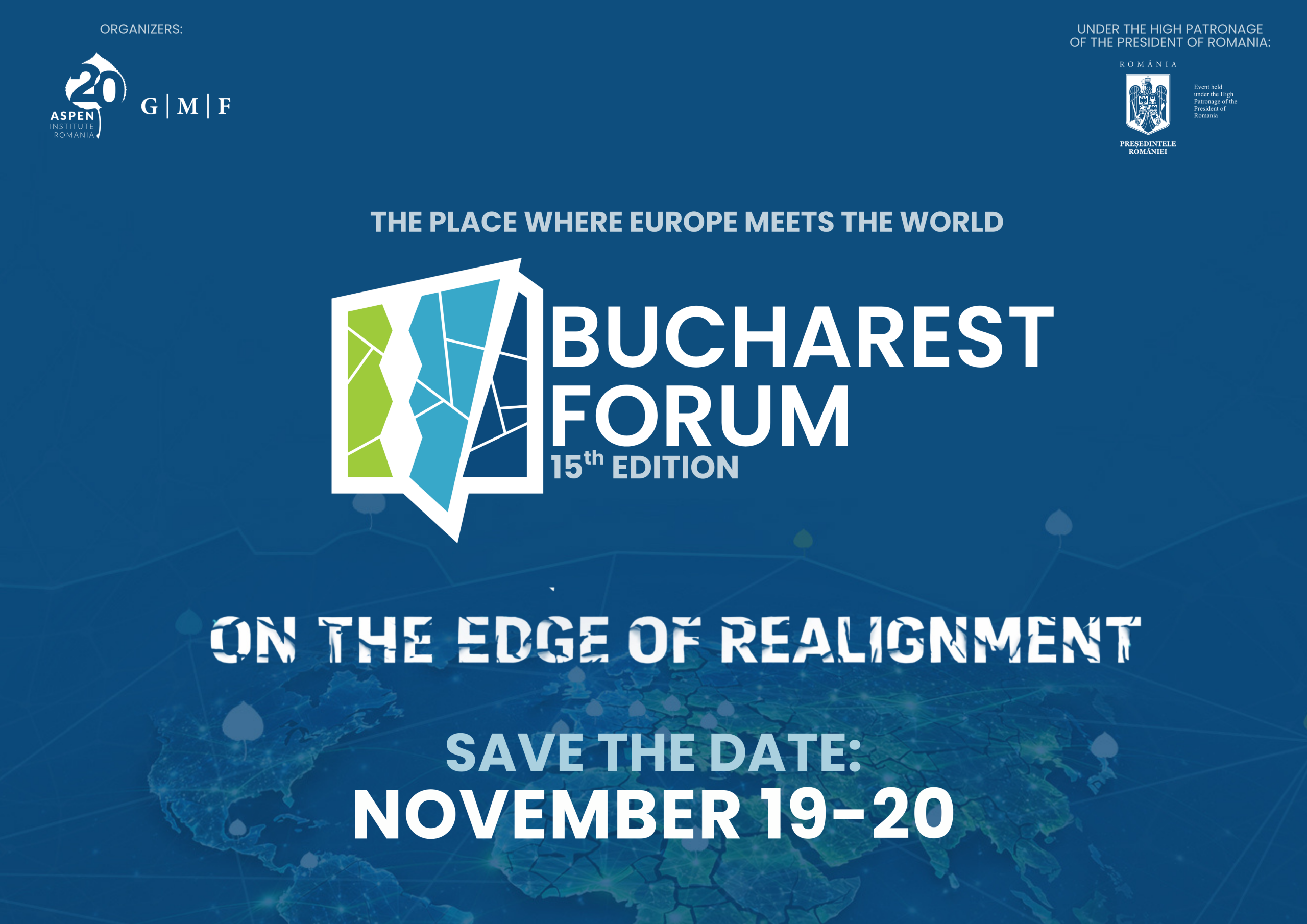
Bucharest Forum 2026
The Place Where Europe Meets the World
15th Edition: On the Edge of Realignment
November 19 – 20 | Bucharest
The Bucharest Forum serves as a premier strategic convening at a critical multiregional intersection—where the West meets the East, and where emerging economies converge with established political powers. As an established public diplomacy event at its 15th edition, the Forum empowers global leaders to engage deeply with the Black Sea region, bridging Trans-Atlantic perspectives and catalyzing a process of reflection on the region’s vital impact on the international agenda.
Co-organizers:
Aspen Institute Romania, German Marshall Fund of the United States
Under the High Patronage of the President of Romania
Institutional Partners:
Government of Romania, Ministry of Foreign Affairs, Ministry of Energy, Ministry of Economy,
Digitalization, Entrepreneurship and Tourism
The world is in the midst of a profound and dynamic re‑alignment: one that touches alliances, economic models, security arrangements, and the very ways in which states and businesses operate. Long‑standing assumptions about stability and predictability are being challenged by shifting geopolitical interests, emerging technological capabilities, and new patterns of interdependence and competition. Traditional partnerships are being reconsidered, new coalitions are forming, and the boundaries between economic, social and security domains are increasingly blurred.
What once seemed like separate spheres (trade, technology, defense, energy) now intersect in ways that redefine strategic priorities and reshape global influence. This re‑alignment is not a temporary disruption but a structural transformation, one that will determine how power is distributed and exercised in the decades ahead.
Technology sits at the center of this transformation. It is no longer merely a driver of innovation or economic growth; it has become a form of strategic infrastructure that reshapes power relations between states, markets, and societies. The world is not fragmenting around technology, but through it. This perspective complements traditional economic analyses by reframing global change through the lens of power distribution and strategic capability.
International governance and multilateralism are also in flux. Existing institutions struggle to adapt, while new formats and coalitions are emerging, still embryonic, still contested, and still heavily influenced by the gravitational pull of major powers. The rules of the game are being rewritten, but the authorship of those rules remains open.
At the edge of this global re‑alignment, countries are experimenting with new strategies to manage uncertainty. They hedge, diversify, decouple and recouple, defend their vulnerabilities, and in some cases push forward assertively to shape the environment to their advantage. Regions situated at the crossroads of geopolitical interests face particular risks: they can easily become arenas for competition rather than agents of their own strategic futures. Their challenge is not simply to navigate, but to do it better than they would in times of stability, with greater foresight, agility, and strategic clarity.
Against this backdrop, this year’s edition of the Bucharest Forum brings together officials, business leaders, experts, and practitioners to collectively draft the emerging playbook of global re‑alignment. The Forum seeks to identify what must change, what must be preserved, and where bold bets should be placed for the future. It is an invitation to think beyond the turbulence of the moment and to shape, rather than merely react to, the world that is taking form.
KEY TOPICS
The major themes to be explored reflect the pressures and possibilities of this moment of re‑alignment:
- Business as (un)usual, examining how companies, institutions and markets have to adapt when geopolitics and political risk become a central variable rather than a distant backdrop; looking at how societies and business readjust to a world where the rules-based system shifts towards a more efficiency/pragmatic – based normalcy;
- Writing the playbook for middle powers, focusing on how states outside the great‑power duopoly can take a more visible stand and shape outcomes, build resilience and preparedness, and play the game of geoeconomics more bravely;
- What are we betting on?, a forward‑looking conversation about the choices, investments, and partnerships that will define competitiveness in the decade ahead in industries like trade, energy, defense, healthcare;
- Future‑Proof or Fall Behind: a candid exploration of how nations and industries can secure their economic and social foundations in an era of accelerating disruption, triggered by geopolitics, technology, AI and pandemics alike; a forward‑looking dialogue on strengthening competitiveness, readiness and resilience to thrive amid uncertainty.
These themes anchor the Forum’s agenda, inviting participants to think boldly about the strategies that can turn uncertainty into opportunity.
A 15-Year Legacy: From Reflection to Resolution
The 15th anniversary edition of the Bucharest Forum represents a landmark moment in our mission to facilitate high-level strategic analysis and inclusive dialogue. Since its inception, the Forum has served as the preeminent platform for decoding the shifts that define our era, fostering a deepened understanding of the challenges and opportunities that lie at the intersection of European and global security. Over fifteen years, Bucharest has emerged not merely as a host, but as a critical strategic vantage point—a “gateway” where the Trans-Atlantic community meets the complexities of the Black Sea and beyond.
Building on a decade and a half of impact, this 15th edition will once again convene a distinguished assembly of heads of state, visionary thinkers, and cross-sector experts. Our goal for this milestone year is to move beyond the identification of global disruptions and toward the delivery of actionable blueprints. As we navigate the settled realities of 2026, the Forum remains dedicated to seeking concrete responses to the most pressing security, economic, and technological questions of our time, ensuring that the next chapter of the Trans-Atlantic story is one of resilience, innovation, and shared prosperity.