




Geopolitics and Security
Summary of Discussion: From Fragmented Procurement to a Regional Hub – The Black Sea Region’s Case for NATO’s Industry Front Door Policy
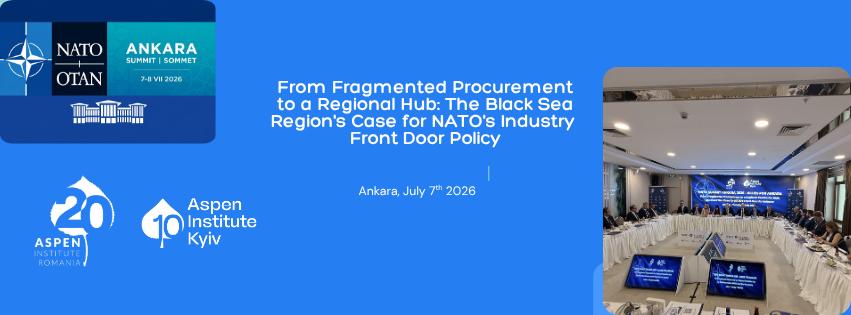
The Aspen Institute Romania and Aspen Institute Kyiv organized a discussion in Ankara, on the sidelines of the NATO Summit, on July 7th, focusing on defense industrial capabilities and innovation in the Black Sea region. Held under the theme “From Fragmented Procurement to a Regional Hub: The Black Sea Region’s Case for NATO’s Industry Front Door Policy“, the event brought together senior government officials, defense industry leaders, and security experts.
The discussions focused on one of the Alliance’s most significant strategic opportunities: the development of a regional defense industrial cluster in the Black Sea region, integrated into NATO’s emerging procurement architecture and industrial cooperation framework through the NATO Industry Front Door initiative.
We would like to thank Munich Security Conference and SETA for offering us the opportunity to organize our conversation under the umbrella of “Allies in Ankara” conference, and our speakers for their contributions: Mircea Geoana – founding president of the Aspen Institute Romania; Benedetta Berti – Secretary General of the NATO Parliamentary Assembly; General Daniel Petrescu – former Chief of Staff of the Romanian Army, and Răzvan Pîrcălăbescu – general director of CN ROMARM SA.
Main Points:
1. Scale up production
The starting premise: budget commitment alone does not equal capability. The 5% pledge only produces deterrence if it converts into actual production volume, inventories, maintenance throughput, and surge capacity, not simply higher national spending lines. Participants agreed that scaling requires the same discipline NATO already applies to military planning through the NDPP, extended into an Industrial Planning Process that asks, for each priority capability: what must be produced, in what quantity, by when, with what supply-chain dependencies, and with what surge capacity.
It might be beneficial to establish either a NATO Industrial Planning Process or an Industrial Delivery Track within the NDPP. The objective of this process would be to bridge the gap between the industrial capabilities required to achieve collectively defined defence capability objectives. If the NDPP provides a framework to inform member states of which defence capabilities are needed, then the industrial track would ask five straightforward questions regarding each of these defence capabilities: 1) What products must be produced? 2) By what quantity must they be produced? 3) When must they be available? 4) With what dependencies in terms of supply chains? 5) With what level of surge capacity in times of crisis or war?
2. Regional lens: leveraging pockets of relevance
Rather than building new regional industrial architecture from scratch, the discussion favored identifying and connecting capability that already exists across the Black Sea littoral: Romanian production and JV capacity (e.g. Rheinmetall-Victoria), Turkish shipbuilding and drone manufacturing volume, Ukraine’s combat-tested innovation speed, Bulgaria’s legacy-caliber production lines, and Greece’s shipbuilding base on NATO’s southern flank. The value-add is an Allied industrial capacity map, covering primes, SMEs, dual-use firms, and critical enablers, that reveals bottlenecks and non-traditional entry points without exposing sensitive commercial detail.
3. Economic spillovers of the defense industry
Participants underlined that a regionally integrated industrial base is not only a security expenditure but a growth vector for frontline economies: skilled manufacturing jobs, dual-use spillovers into logistics and cybersecurity, and a stronger case for treating frontline-state defense assets as investable rather than politically exposed. This reframes defense-industrial investment as regional economic development, not solely deterrence cost.
4. Aggregated demand and matchmaking
Fragmentation was identified as fundamentally a demand-signal problem, not a production problem: individual national orders (Romanian, Bulgarian, Greek) are each too small to justify the capital expenditure required for competitive regional production. Aggregating demand through joint procurement, pooled munitions contracts, and common-funded enabler infrastructure (ports, rail-heads, ammunition storage) converts fragmented demand into bankable scale. A genuine “front-door for business” giving SMEs and dual-use firms clear visibility into demand, standards, certification, and consortia access, was flagged as the practical mechanism to operationalize matchmaking, rather than another dialogue platform.
5. Lessons learned: Iran and Ukraine
Two parallel lessons were drawn. From Ukraine: innovation speed and institutional scaffolding are separate variables, Ukraine outpaces every NATO procurement system on iteration speed, but that speed has outrun the certification, standardization, and financing architecture needed to scale innovation into durable capacity. From the Iran conflict: sustained missile and drone exchanges expose how quickly layered air defense inventories deplete, underscoring that surge production and stockpile depth matter more than peacetime procurement assumptions allow for. The region was urged to build pre-agreed surge capacity and replenishment timelines into industrial planning now, rather than improvising under pressure later.
6. Directing 20% of the 5% to innovation
Discussion converged on testing, at Black Sea regional level, the emerging principle that a defined share (around one-fifth) of the 5% GDP commitment should be earmarked specifically for innovation, non-traditional suppliers, and dual-use capability, rather than defaulting to legacy replenishment through large primes. This was seen as the mechanism best suited to capture the region’s actual comparative advantage: Ukrainian iteration speed and the drone/counter-drone ecosystems emerging across the littoral states.
7. Attracting and involving private capital
Private capital appetite exists but will not move toward opacity. The discussion concluded that a regional industrial capacity map, aggregated demand signals, and predictable multi-year procurement pipelines are the preconditions for converting Black Sea defense assets into instruments a financing vehicle, including a dedicated defense, security, and resilience bank, can credibly underwrite. The binding constraint is visibility and standardization, not investor interest.
Overall conclusions and next steps
The discussion converged on a single operating principle: the Black Sea becomes a credible contributor to European deterrence not by accumulating more national programs, but by converting existing, uneven capability into a system with shared demand signals, shared standards, and shared financing logic, with an innovation earmark and private capital mobilization built in from the start rather than added later.
The conclusions of the Ankara discussion will be carried forward in September at the Aspen European Strategic Forum in Brussels and in November during the 15th edition of the Bucharest Forum, organized by the Aspen Institute Romania in partnership with the German Marshall Fund (GMF) and dedicated to foreign policy and security issues.
By convening this discussion, the Aspen Institute Romania aims to advance the strategic dialogue on Euro-Atlantic security and foster closer cooperation between Allied governments and the defense industry at a time when strengthening NATO’s capabilities remains one of the Alliance’s top priorities.
We thank all participants for a consistent and solution-oriented conversation. Strengthening regional cooperation and developing a strong defence industrial base in the Black Sea region represents a strategic opportunity to strengthen the Alliance’s resilience and deterrence capability.